
Densifying without Sealing - Research on the sustainable transformation of existing single-family neighbourhoods
Short Description
Background/Motivation
With the objective of achieving climate neutrality by 2040, urban development is experiencing a significant transformation. Intensifying existing residential zones has emerged as a pivotal strategy for sustainable, climate-aware expansion.
Suburban single-family housing estates, characterized by low-density land utilization yet robust infrastructure linkages, present an untapped opportunity for metamorphosis.
Contents and goals
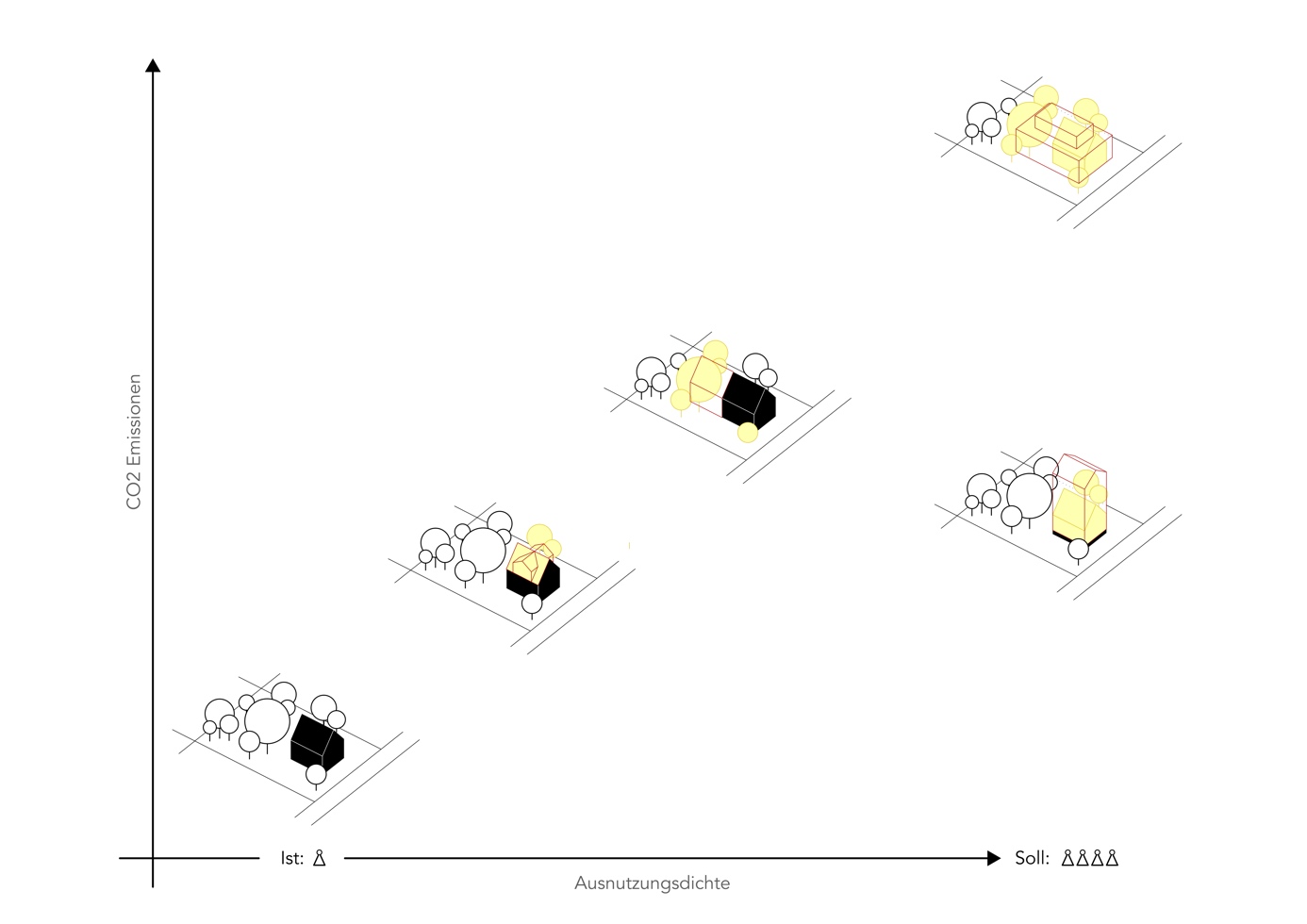
The research initiative „Densifying Without Sealing (1)" confronts this challenge directly. It investigates an innovative, scalable, and property-friendly methodology designed to substantially increase density in single-family neighbourhoods—by as much as fourfold—without necessitating additional land sealing.
In contrast to conventional methods that depend on energy-intensive demolition and horizontal new constructions, or minor extensions with limited effect, this project employs an integrated strategy. By incorporating vertical extensions on existing building footprints, it significantly enhances usable space without infringing upon green areas.
Methodical Approach
Leveraging existing basements conserves embodied energy, optimizes the use of current infrastructure, and obviates the need for new excavations. Moreover, materials from obsolete structures are evaluated for reuse, promoting circular economy principles and reducing resource consumption.
At a neighbourhood level, this approach aids in preserving mature green spaces, maintaining the character of leafy, detached homes. More broadly, protecting private green areas and averting new land sealing are crucial for sustaining urban microclimates.
The project adopts an interdisciplinary perspective, concentrating not only on architectural and economic viability but also on community impacts.
Expected Results
In alignment with the New European Bauhaus principles of sustainability, aesthetics, and inclusion, it critically assesses zoning restrictions and evaluates public acceptance of denser, mixed-use environments through participatory processes.
Ultimately, this establishes the foundation for a demonstration project that could significantly contribute to land-efficient, resource-conscious, and climate-resilient urban development.
Its scalable approach offers inspiration for cities, municipalities, developers, and planners seeking innovative solutions to transform existing residential landscapes.
Project Partners
Project management
Institute of design in existing structures and architectural heritage protection
Project or cooperation partners
- Institute of structural design
- Sustainable Construction
- Sonja Gruber, Sonja Gruber, Soziologie & Sozialanthropologie
Contact Address
Dr. Svenja Hollstein
Institute of design in existing structures and
architectural heritage protection
Lessingstraße 27
A-8010 Graz
Tel.: +43 (0316) 873 6271
E-mai: office.enbede@tugraz.at