
ClimateConcrete Bregenz - Model development of transferable NEB quality processes for climate-resilient urban districts in Bregenz
Short Description
Starting point / motivation
Bregenz has a high level of design quality, strong urban planning standards, and strategic planning expertise. At the same time, there is a challenge to further develop key districts in a future-oriented way with regard to climate protection, social inclusion, and building culture.
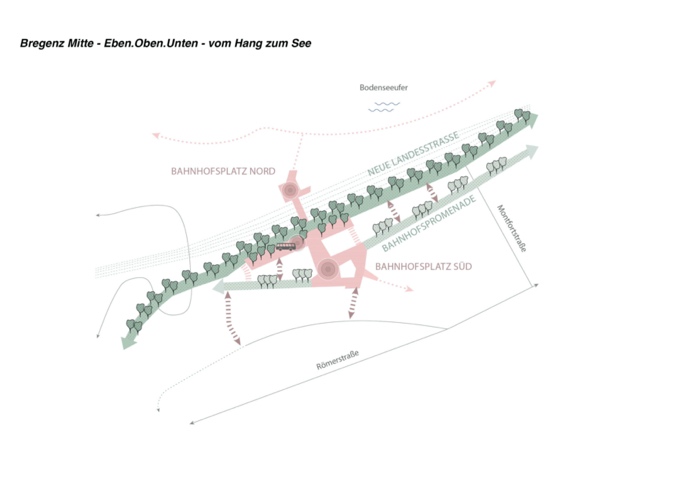
With Bregenz Mitte and the Weiherviertel, two differently structured transformation areas have been identified, both of which are already embedded at the municipal level. Bregenz Mitte includes the city center, the area around the railway station, and the interface with the lake—making it a strategically important development area with demands related to mobility, mixed-use development, spatial quality, and open space.
The Weiherviertel, by contrast, is more strongly shaped by its social environment, with educational, social, and cultural institutions in close proximity. It offers particular potential for participatory development, social integration, and the enhancement of open spaces.
Both districts provide ideal conditions for testing new approaches to integrated, quality-assured urban development in line with the principles of the New European Bauhaus (NEB).
Contents and goals
"Klima konkret Bregenz" aims to develop a transferable planning and process model for climate-resilient, socially equitable, and high-quality urban districts in terms of design. At its core is a quality assurance roadmap based on the four NEB dimensions:
- process quality,
- ecological sustainability,
- aesthetics, and
- social inclusion.
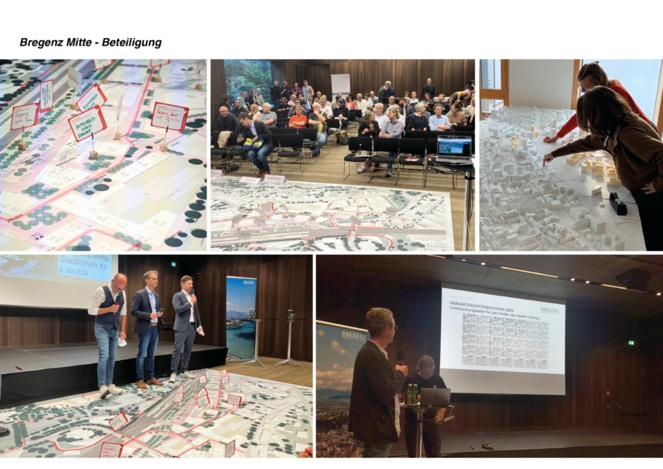
The methodological approach combines integrated planning, interdisciplinary collaboration, gender-sensitive participation, and strategic governance—with a focus on low-threshold involvement of relevant stakeholders. Both districts serve as real-world experimental settings to test and further develop methods, structures, and formats within everyday municipal practice.
What is innovative is the parallel development of differently structured districts, the consistent operationalization of qualitative goals, and the early involvement of diverse stakeholder groups. Existing standards such as klimaaktiv settlements and districts, as well as the criteria matrix from NEBKritQ, are adapted for practical application in the municipal context.
The project structure promotes institutional learning and prepares implementation through clear cooperation pathways, consensus-oriented guiding principles, and scalable participation formats.
Methods
The methodological research design is based on transdisciplinary co-production, iterative learning cycles, and continuous evaluation. It includes a comprehensive stakeholder analysis, the development of quality profiles based on the NEBKritQ criteria, the creation of spatial visions, and the formulation of cross-departmental governance models. The planned participation formats take into account low-threshold, inclusive approaches that incorporate barrier-free access and a variety of communication channels.
Gender relevance is systematically embedded in all project phases. This includes a differentiated spatial analysis with regard to gender-specific needs, the design of participatory processes, the use of gender-sensitive language, and the consideration of diverse life realities in addressing target groups. The aim is to make the project's impact on all genders and social groups visible and to create enabling conditions for equality and participation.
Expected results
A transferable quality assurance roadmap with formats for cross-departmental coordination, scheduling, participation, spatial visions, and governance. A modular toolbox of methods and criteria based on NEBKritQ and klimaaktiv settlements and districts.
Concrete strategies for social inclusion, such as gender-sensitive planning, barrier-free access, socially oriented participation, educational and youth programs, cultural interfaces, and equitable mobility options. Documented and evaluated guidelines for process-based quality assurance in municipal transformation.
This results in a robust model for high-quality, participatory urban development—compatible with municipal programs and transferable to other cities.
Project Partners
Project management
bauchplan ).(
Project or cooperation partners
StudioVlayStreeruwitz, con.sens Mobilitätsplanung, urban policy, Wolfgang Ritsch
Contact Address
bauchplan ).(
Marie-Theres Okresek, Dipl.-Ing.
Endresstrasse 18
A-1230 Vienna
Tel.: +43 (1) 929 13 33
E-mail: studio@bauchplan.at
E-mail: bregenz@bauchplan.at
Web: www.bauchplan.net